Fish
Identification
Use several traits together—body profile, mouth position, fin shape, markings and habitat. Color alone changes with water, season, age and stress.
Use several traits together—body profile, mouth position, fin shape, markings and habitat. Color alone changes with water, season, age and stress.
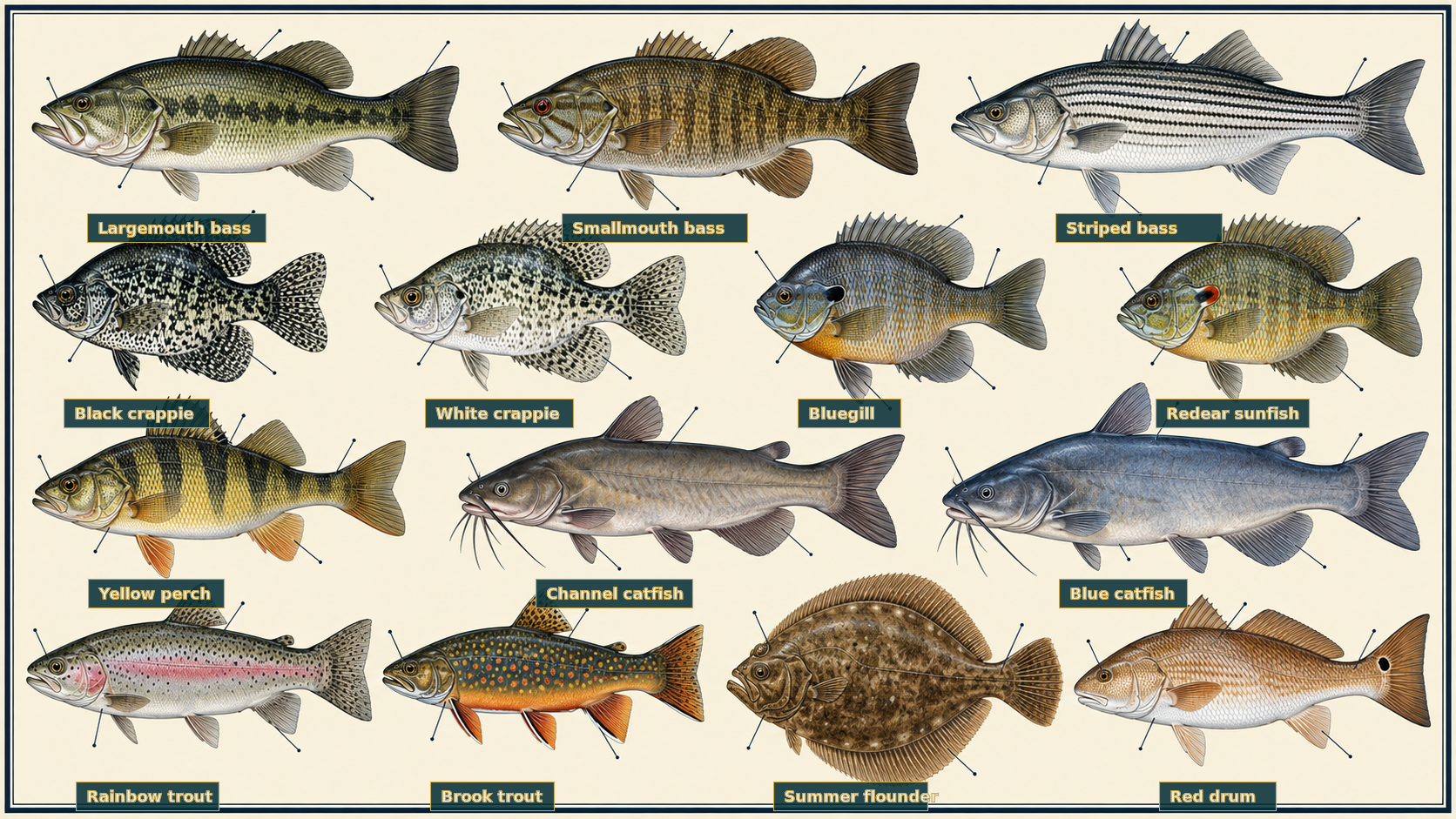
Look for: jaw beyond eye; deep mouth; broken dark lateral band.
Look for: jaw near eye; bronze body; vertical bars.
Look for: streamlined silver body with horizontal stripes and separated dorsal fins.
Look for: irregular black mottling; usually seven or eight dorsal spines.
Look for: dark vertical bars; usually five or six dorsal spines.
Look for: deep body, small mouth, dark ear flap and dorsal spot.
Look for: red or orange ear-flap margin and slightly larger mouth.
Look for: yellow-gold sides, dark vertical bars and orange lower fins.
Look for: forked tail, young-fish spots and curved anal-fin edge.
Look for: forked tail, slate-blue body and long straight-edged anal fin.
Look for: pink lateral wash and black spots across body and tail.
Look for: pale wormlike marks, red blue-haloed spots and white fin edges.
Look for: both eyes on the left side, flat body and ocellated spots.
Look for: copper-bronze body and black spot near the tail base.